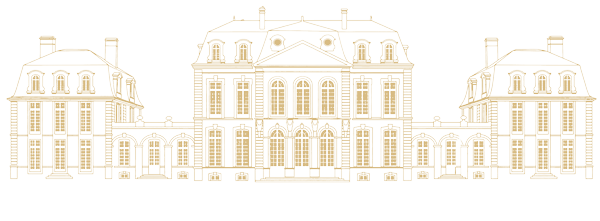
THE CASTLE
THE VESTIBULE
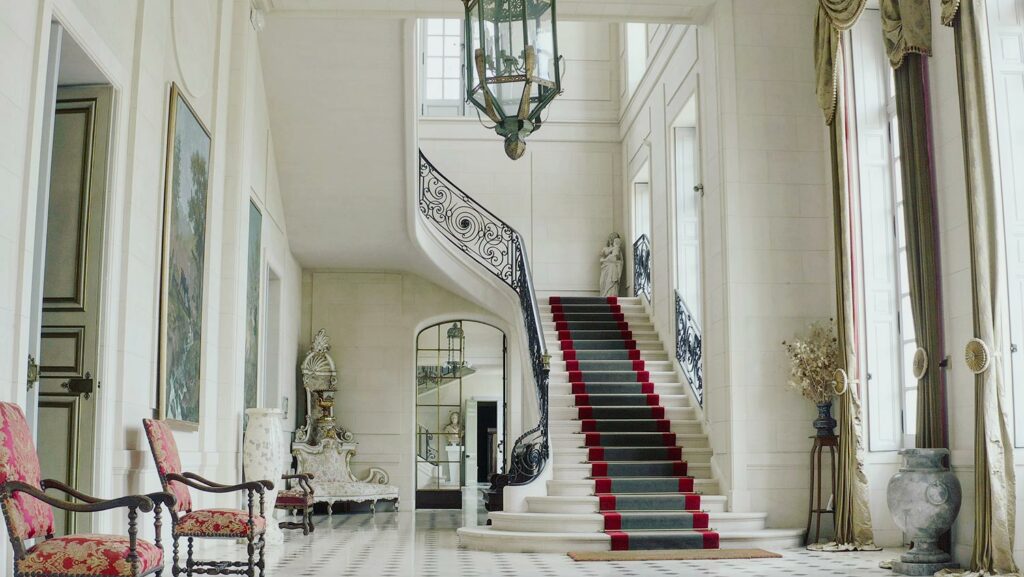
The vestibule is the main entrance to the château’s interiors.
Measuring 23 metres long, 6 metres wide and nearly 6 metres high, it impresses with its majestic proportions.
The renowned architect Coulomb enhanced its spectacular effect by placing, to the right, a grand staircase with an intermediate landing and a fine wrought-iron balustrade leading to the first floor.
The scale and solemnity of this space reflect the period’s taste for theatricality and architectural grandeur. This vestibule is decorated with paintings illustrating La Fontaine’s Fables : eight painted tapestry cartoons, used as models by weavers for the creation of tapestries.
The vestibule provides access to the Salon des Batailles and the Grand Salon, setting the tone for the refinement and harmony of the Château des Ormes’ interiors.
THE SALON OF BATTLES
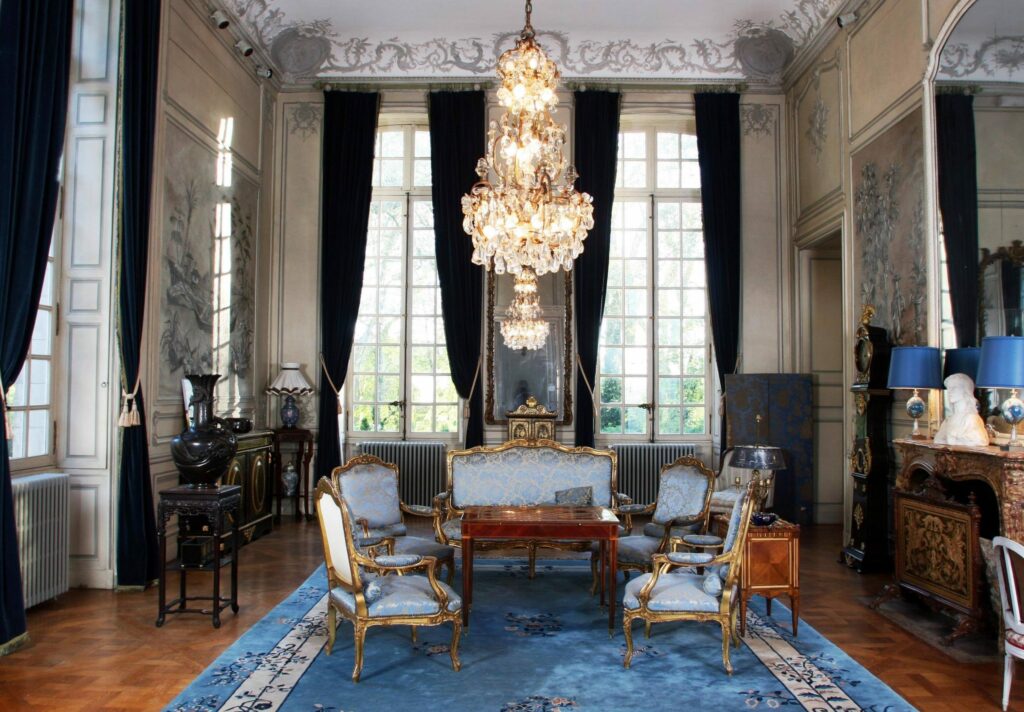
Located to the right of the vestibule, the Salon of Battles pays tribute to the military achievements of the Comte d’Argenson, Minister of War under Louis XV.
Its walls were once adorned with large paintings by Pierre Lenfant, notably depicting the Battle of Fontenoy, a decisive victory in 1745.
These canvases, now dispersed, were later replaced by decorative panels painted with Chinese scenes, reflecting the evolution of taste and the refinement of interior decoration over time.
A testament to glory and loyalty, the history of this salon recalls how, in the 18th century, the Château des Ormes was a place of prestige and influence.
This salon displays several fortepianos from the personal collection of Mr Sydney Abbou, ancestors of the modern piano—keyboard instruments with five octaves and struck strings—including an Érard from 1789 as well as more recent models dating from 1810 to 1860.
THE GRAND SALON
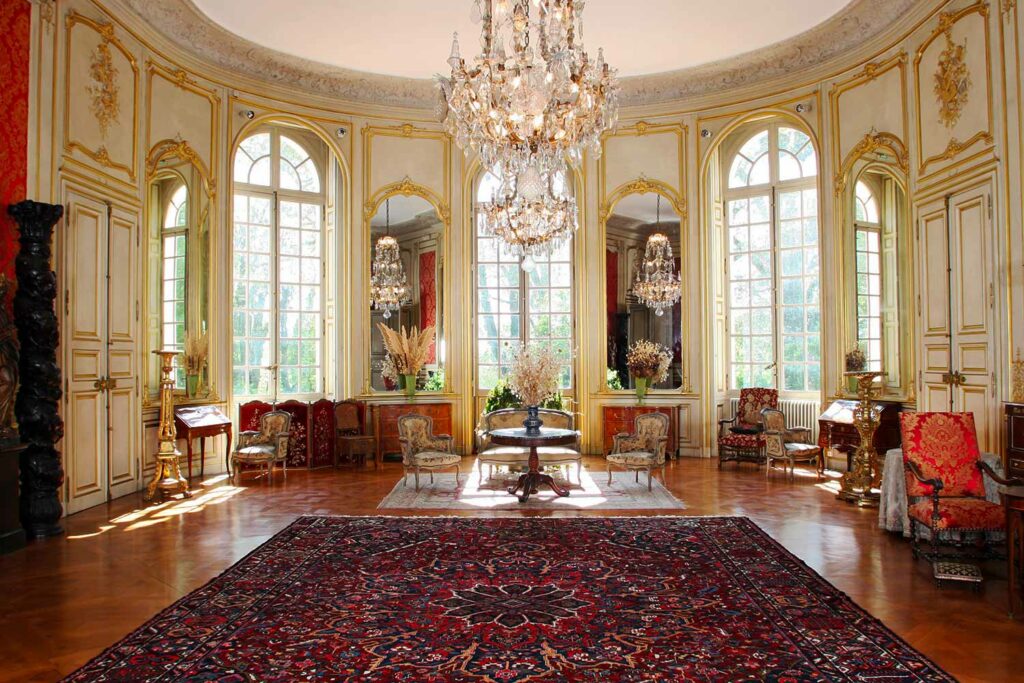
The Grand Salon is one of the château’s most magnificent state rooms.
With its harmonious proportions, thoughtful layout and luminous clarity, it perfectly reflects the architectural refinement of the 18th century, marked by a taste for symmetry and light.
Carved wood panelling, enhanced with gilding, frames large mirrors and accentuates the height of the ceiling.
This room, both a reception and ceremonial space, once housed, during the d’Argenson family’s time, the Gobelins tapestries devoted to the History of Don Quixote, woven between 1732 and 1736.
Presented in 1736 by Philippe d’Orléans, the Regent, to the Comte d’Argenson as a token of friendship and gratitude, they recall the minister’s distinguished place in the political and artistic life of his century. These tapestries, donated to the French State through a dation, are now preserved and displayed at the Louvre Museum. The Louvre curator authorized the owner to produce a reproduction, which is presented to visitors at the Château des Ormes.
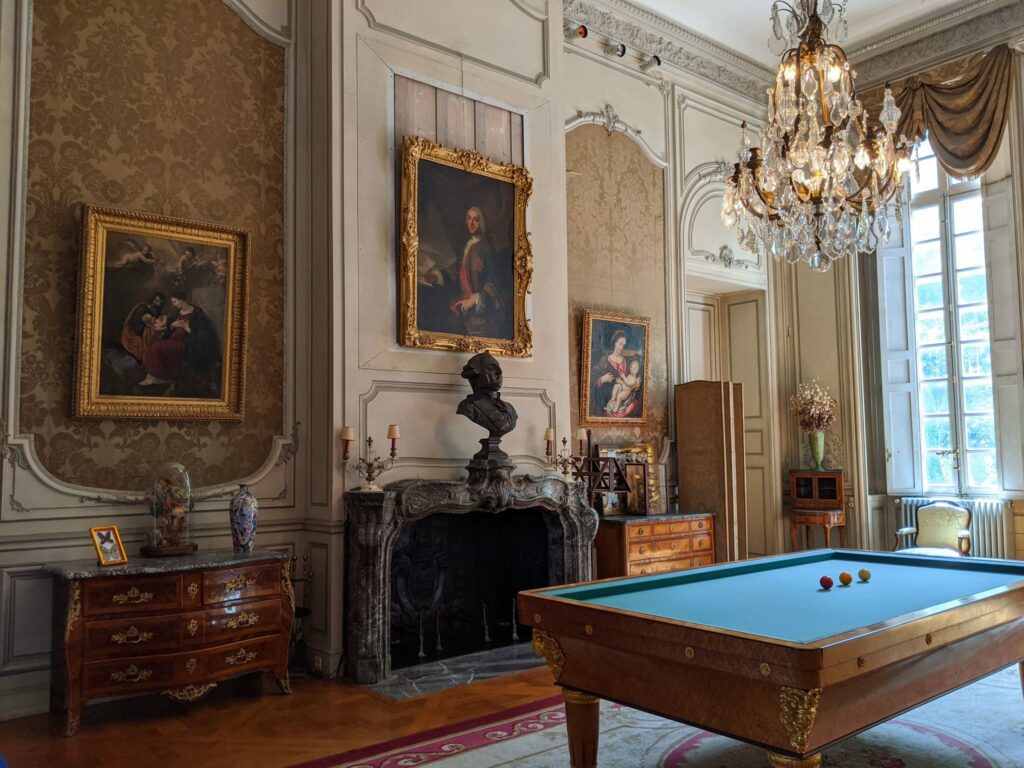
THE SMALL DRAWING ROOM OR BILLIARD ROOM
Now used as a billiard room, this salon was referred to as the “Small Room” in the memoirs of painters Taillebourg and Voyer in 1905–1906.
Like the Salon of Battles, it extended the central salon during major receptions.
The room contains an 18th-century fireplace, the second in the central wing, designed in 1750 by the renowned ornamental sculptor Nicolas Pineau (1684–1754) for the gallery of the Château d’Asnières, the Marquis de Voyer’s first major architectural work (1750–1752).
This exuberant rococo fireplace was identified thanks to its trompe-l’œil model preserved at the Hermitage Museum in Saint Petersburg.
It was acquired by the d’Argenson family at the end of the 19th century, during the dismantling of the décor of the Château d’Asnières.
THE DINING ROOM
THE LIBRARY
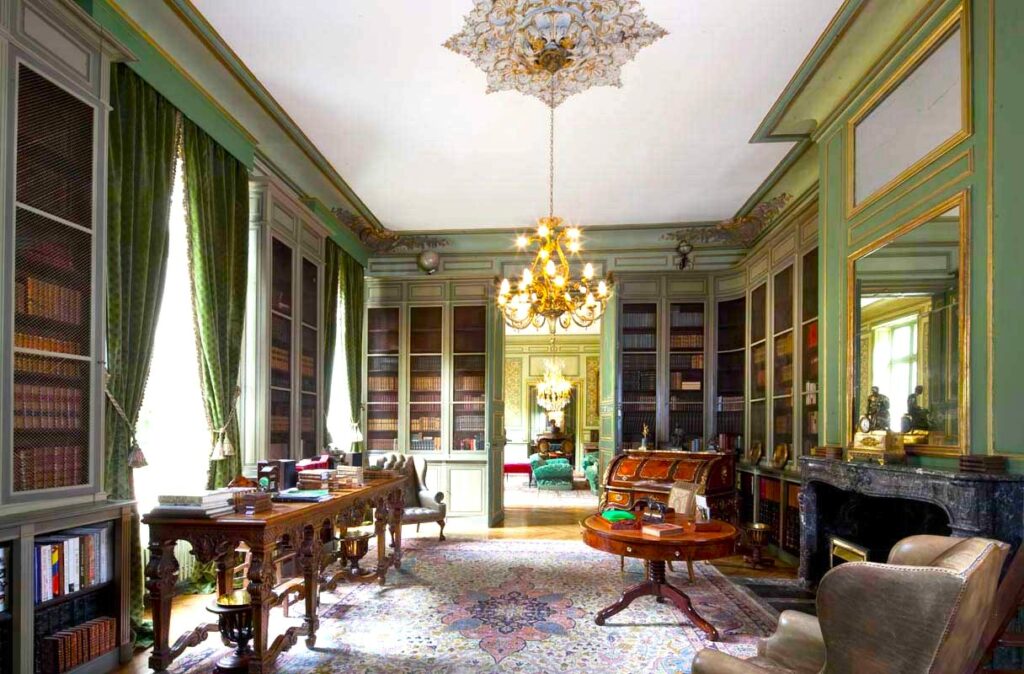
Under the comte Marc-Pierre d’Argenson — one of the most eminent bibliophiles of his time — the library contained over 6,000 volumes.
After the transfer of its finest works to the marquis de Paulmy in 1764, now preserved at the Bibliothèque de l’Arsenal in Paris, the collection was later enriched by the marquis de Voyer at the end of the 18th century, and by Sophie de Rosen, wife of the marquis d’Argenson, in 1801.
By the early 20th century, it held nearly 8,000 volumes.
Divided into three large rooms by marquis Marc-René-Marie d’Argenson during the Consulate, two of them were restored by Mr Sydney Abbou, the château’s current owner, in the 2000s to revive their former splendour.